Key Takeaways
- Facebook organic reach fell from ~16% in 2012 to 2–5% in 2026 (HubSpot, 2026) — most equestrian posts are invisible without paid support.
- Social platforms restrict organic reach deliberately to monetise distribution through advertising — this is not a temporary glitch.
- Three proven alternatives exist: paid social advertising, media distribution partnerships, and owned channels like email lists.
- Equestrian brands that distribute through established media networks reach engaged horse audiences without building from zero.
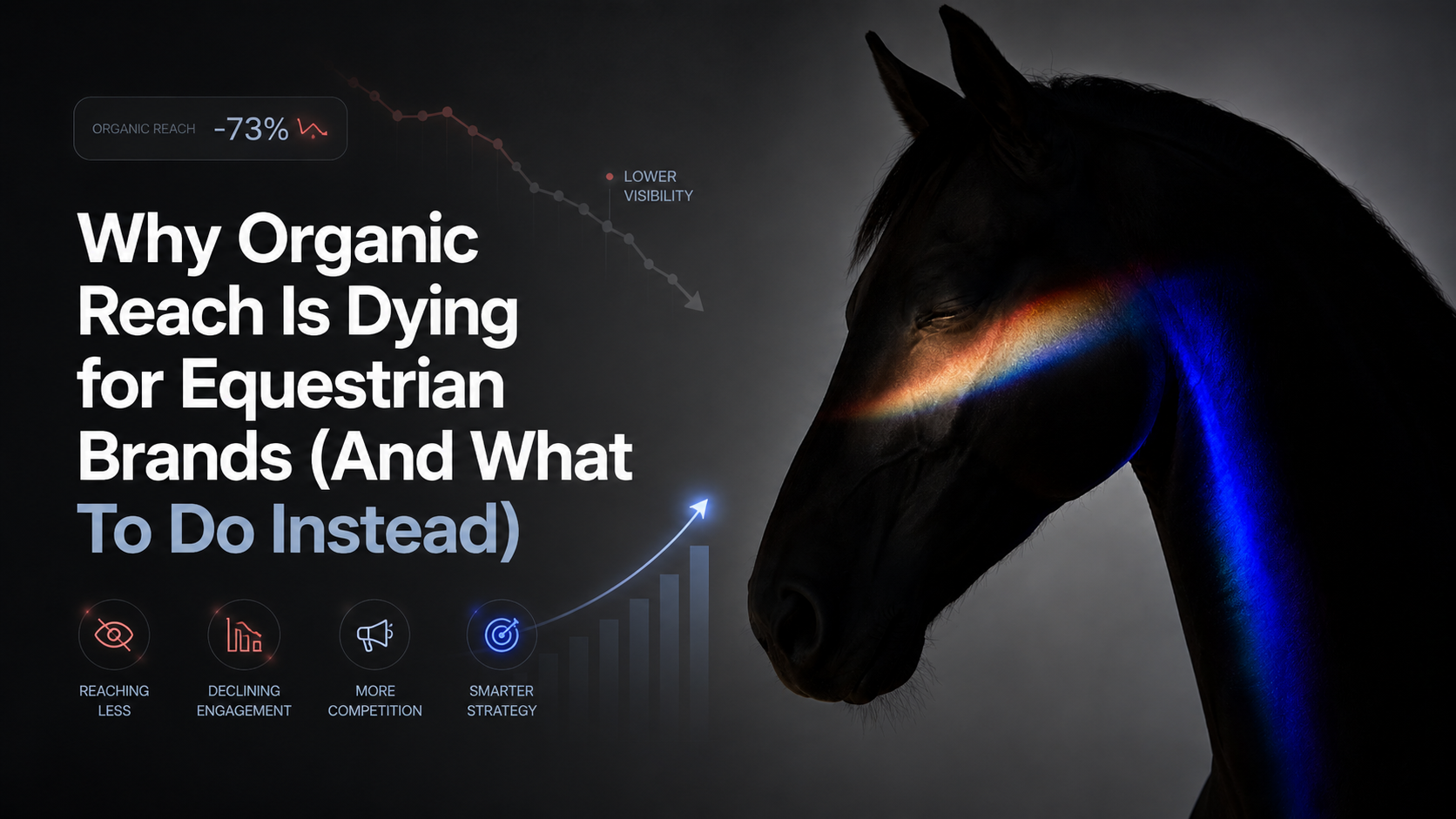
Organic reach for equestrian brands on Facebook has dropped to between 2% and 5% of followers (HubSpot, 2026). If your equestrian page has 20,000 followers, the average post is seen by fewer than 1,000 people — and that number is still declining. Understanding why this happens, and what the actual alternatives are, is now the most important marketing question for any horse brand trying to grow.
What Happened to Organic Reach on Social Media?
Organic Facebook reach dropped from approximately 16% in 2012 to under 5% by 2026 for most brand pages (HubSpot, 2026). Instagram followed the same trajectory after its algorithm shift away from chronological feeds. The mechanism is straightforward: social platforms are advertising businesses. When they reduce organic reach, brands are forced to pay for the visibility they previously received for free. This is not accidental — it is the deliberate business model of every major social network.
According to HubSpot's 2026 marketing data, organic Facebook reach for brand pages now averages between 2% and 5% of total followers. For an equestrian brand with 15,000 followers, the typical post reaches 300 to 750 people — a fraction of the audience that originally chose to follow the page.
Why This Hits Equestrian Brands Harder Than Other Industries
Equestrian businesses face a compounding challenge that most general marketing advice doesn't account for.
First, equestrian audiences are concentrated on Facebook specifically — the platform with the most advanced audience decline. The core demographic of serious horse owners, buyers, and competition participants skews toward 30–55 year olds, and that demographic lives on Facebook more than any other platform.
Second, equestrian brands typically have smaller marketing budgets than mainstream consumer brands. A farrier, a small saddlery, or a regional horse show can't afford the paid social budgets that offset organic decline for larger companies.
Third, most equestrian content agencies have not updated their advice. They still sell content packages based on posting frequency — as if showing up consistently would overcome a structural algorithmic problem. Posting three times a week on an account that reaches 3% of its followers is still reaching 3% of its followers. More posts don't fix a reach problem.
What Are the Real Alternatives?
1. Paid Social Advertising
Facebook and Instagram advertising remains extremely effective for equestrian brands despite organic decline — because paid reach bypasses the organic algorithm entirely. A well-structured Facebook ad campaign can reach tens of thousands of targeted horse owners for a fraction of what traditional advertising costs. Facebook's ad platform allows targeting by interests (horseback riding, dressage, show jumping, equestrian equipment), behaviours, demographics, and geographic radius.
2. Distribution Through Established Equestrian Media
This is the fastest path to equestrian audience reach, and the least discussed option in the industry. Instead of building a following from zero, equestrian brands can distribute their content through pages that already have large, engaged horse-loving audiences. When a brand is featured by an equestrian media account with hundreds of thousands of followers, it reaches that audience instantly — with the added credibility of being endorsed by a trusted source.
DigiHorse Media's network — including Horse Lovers, HL Arena, HL Horseshoeing, Horse Lovers Travel, and other horse-focused channels built since 2014 — reaches one of the world's largest equestrian digital audiences. Brands that partner with the network get distribution without the years of audience-building required to achieve it independently.
3. Owned Channels: Email Lists and Direct Contact
Social media platforms own your audience. Email lists belong to you. The equestrian brands with the most resilient marketing use social media as a funnel — not the destination. Email marketing delivers an average ROI of $42 for every $1 spent (Litmus, 2025). Building an email list through free guides, discount codes, training tips, or event updates creates a direct line to buyers that operates independently of whatever social platforms do next.
What About TikTok?
TikTok remains the most generous platform for organic reach in 2026. Its algorithm distributes content based on quality signals rather than account size — a farrier with 500 followers can reach 100,000 viewers on a single clip. However, TikTok's audience skews younger than the core equestrian buyer demographic, and regulatory uncertainty in key markets limits it as a primary platform. TikTok is worth building on, especially for brands targeting younger riders — but as part of a multi-platform strategy, not a replacement for one.
How to Diagnose Your Current Reach Problem
Pull 90 days of data from your primary platform and calculate:
Reach rate = Total unique accounts reached ÷ Total followers × 100
If your reach rate is below 10%, organic strategy alone will not grow your business at a meaningful pace. Below 5%, you need distribution support immediately.
Engagement rate on reach = Total interactions ÷ Total reach × 100
High engagement on low reach means your content quality is fine — your distribution is the problem. Low engagement on decent reach means the content needs work.
The Realistic Path Forward
The equestrian brands that will grow fastest in 2026 and beyond will combine:
- Quality content that gives the audience a reason to stop and engage
- Paid advertising on Facebook and Instagram targeting precisely defined equestrian audiences
- Media distribution partnerships that put the brand in front of established equestrian communities
- Email list building as the long-term audience asset that no algorithm can remove
Frequently Asked Questions
Has organic reach completely died on Facebook for horse brands?
Not completely, but it has declined to the point where it can no longer drive meaningful growth alone. Facebook organic reach averages 2–5% for brand pages (HubSpot, 2026). That's sufficient for maintaining visibility with existing customers, but not enough to grow a business or reach new buyers consistently.
Is TikTok a better option than Facebook for equestrian brands?
TikTok currently offers better organic reach than Facebook, particularly for behind-the-scenes and personality-driven horse videos. However, TikTok's audience skews younger than the core equestrian buyer demographic and the platform carries regulatory uncertainty. Most equestrian brands benefit from using both, with TikTok for discovery and Facebook for targeting and conversion.
How much should an equestrian brand spend on paid social media?
A sensible starting point for a small equestrian business is €300–€800 per month in paid Facebook advertising, used for targeted campaigns rather than general page boosting. Scale from results rather than starting with a large budget before testing.
What is equestrian media distribution and how does it work?
Equestrian media distribution means getting your brand featured through established media accounts that already have large, trusted equestrian followings — giving you immediate reach without building an audience from scratch. DigiHorse Media works with equestrian brands this way across a network built since 2014.
Should I focus on growing my own social following or use distribution partners?
Both serve different purposes. Building your own following creates a long-term asset. Distribution partnerships create immediate reach at scale. The most effective approach combines both: use media distribution to reach new audiences quickly, while converting that reach into your own followers and email list over time.
DigiHorse Media helps equestrian brands solve the reach problem — not just through content strategy, but through direct distribution to horse-loving audiences built across our network since 2014. Talk to us about your brand's reach goals.
.png)